GPT-5 is OpenAI's next-generation unified language model designed to dynamically switch between fast responses and deep reasoning based on prompt complexity. Built as a single cohesive system, GPT-5 reduces hallucinations, improves performance on complex tasks like programming and medicine, and introduces custom control parameters like verbosity and reasoning effort. To support diverse business needs, OpenAI also launched smaller, optimized variants: GPT-5 Mini and GPT-5 Nano.
To give developers and businesses more flexibility, OpenAI also introduced smaller versions of the model called GPT-5 Mini and GPT-5 Nano. These versions are optimized for speed and lower costs while still delivering strong performance for lighter tasks.
How GPT-5 Works as a Unified System
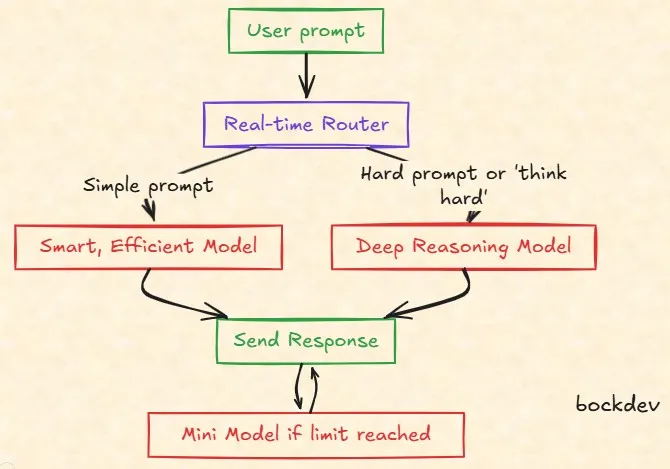
One Unified System of GPT-5.
GPT-5 works as a unified system with three parts: a smart, efficient model for most questions, a deeper reasoning model for tougher problems, and a real-time router that picks the right one based on your question and how complex it is. If you ask it to "think hard," it knows to switch to the deeper model. The router keeps learning and improving by looking at how people use the system and which answers they prefer. If you hit your usage limit, smaller versions of the models take over.
GPT-5 vs. GPT-4o Comparison
| Feature | GPT-5 | GPT-4o |
|---|
| Reasoning | Dynamic switching between fast and deep reasoning | Optimized for speed but less nuanced reasoning |
| Accuracy | ~45% fewer hallucinations | Higher error rates |
| Writing | Handles complex structures and formats | General writing support |
| Coding | Best-in-class on SWE-bench Verified (74.9%) | Competent but less advanced |
| Health | Higher scores on HealthBench | Lower performance in health-related queries |
| Customization | Supports verbosity and reasoning_effort | Limited user-level controls |
GPT-5 is much smarter overall, showing better results in tests, especially in math, coding, visual tasks, and health. It sets:
PhD-level science questions -> 85.7% on GPQA with thinking and no tools.
Competition math -> 94.6% on AIME 2025 without tools.
Real-world coding -> 74.9% on SWE-bench Verified.
Multimodal understanding -> 84.2% on MMMU.
Health -> 46.2% on HealthBench Hard.
GPT-5 API Pricing and Models
| Model | Input | Output |
|---|
| GPT-5 | $1.25 | $10.00 |
| GPT-5 mini | $0.25 | $2.00 |
| GPT-5 nano | $0.05 | $0.40 |
| GPT-4o | $2.50 | $10.00 |
NOTE
Input token of GPT-5 is 50% cheaper than GPT-4o.
References