Photonic Matrix Processing: How Light Powers Faster Neural Networks
Photonic matrix processing uses light instead of electricity to run the matrix math behind neural networks, cutting energy use and boosting speed.
Every time a neural network makes a prediction, it runs millions of matrix multiplications under the hood. That math is the real bottleneck. GPUs are fast, but they burn enormous amounts of power and still struggle to keep up with how big AI models have become.
What if you could do that same math at the speed of light, using almost no energy? That's not science fiction anymore. Photonic matrix processing is a real, working approach where light, not electricity, carries out the core calculations that power neural networks.
In this post, we'll break down what photonic matrix processing actually is, how it works, who's building it, and why it might shape the next generation of AI hardware.
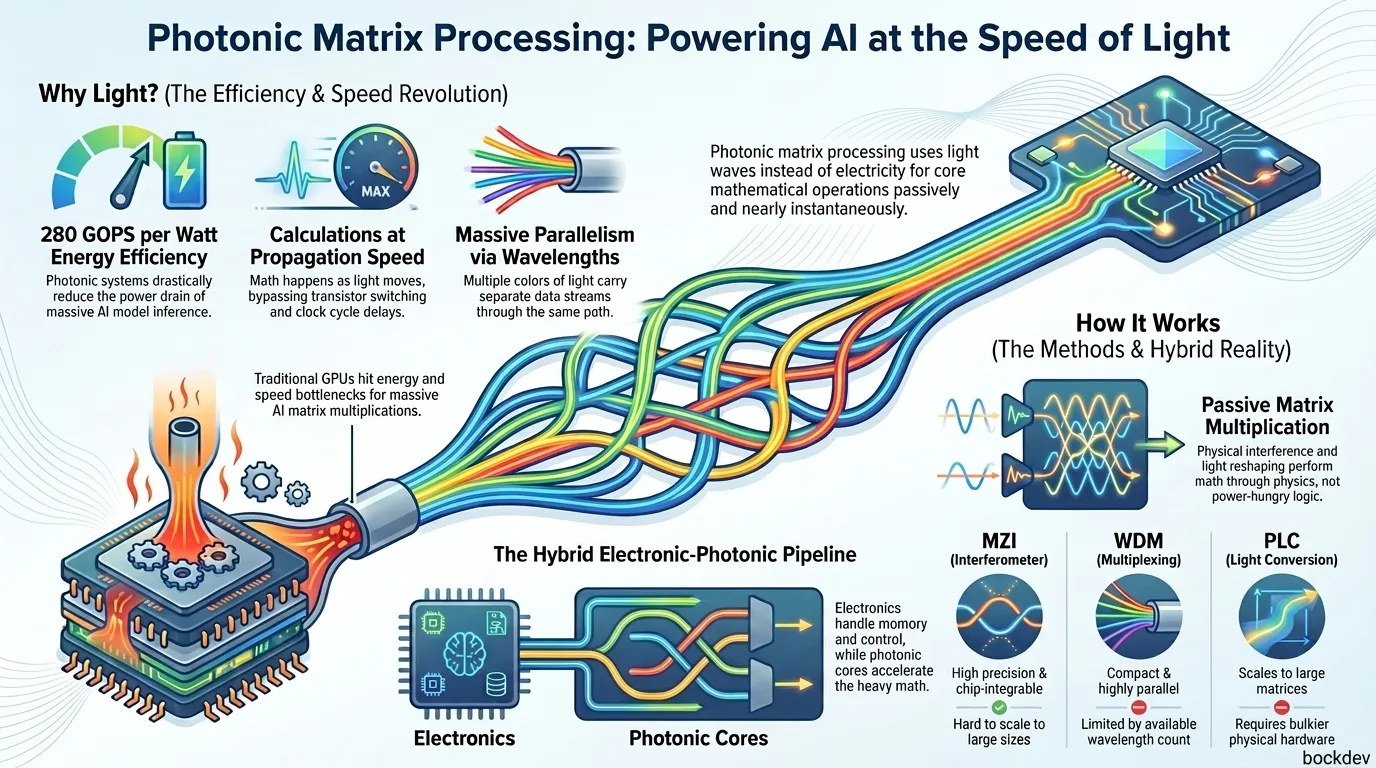
Photonic matrix processing means using light waves, instead of electrical signals, to perform matrix multiplication, the core operation in neural networks.
In a normal GPU, numbers are stored as electrical charge and pushed through transistors. In a photonic chip, numbers are encoded into light, light beams interfere or combine, and the result of that interference is the answer to the multiplication.
Here's the key idea in plain terms:
A neural network layer is basically: output = input × weights
That's a matrix multiplication
Photonic chips can do this multiplication passively, just by letting light pass through optical components
No clock cycles, no switching transistors, just physics doing the math
This matters because matrix multiplication is repeated billions of times during training and inference. If you can do it with light, you save massive amounts of energy and time.
Light is split into two paths, each path's phase is adjusted slightly, and when the paths recombine, the interference pattern represents a multiplication result. This approach was first shown by Soljačić and colleagues in 2017, who built a fully optical feed-forward neural network using 56 programmable MZIs for analog light-based computation.
It's precise but takes up physical chip space, which limits how large the array can get.
Instead of one light beam, this method uses many different colors (wavelengths) of light at once, each carrying its own data stream in parallel.
The scale of WDM-based methods is limited by how many wavelengths are available, though soliton crystal microcombs have allowed scaling to around 100 channels when all wavelengths are dedicated to a single matrix multiplication.
It's compact and great for parallelism, but you need very stable, well-calibrated light sources.
Light passes through a diffractive or holographic surface that reshapes the beam, this reshaping itself performs the matrix operation. It can scale to large matrix sizes but the physical hardware tends to be bulkier.
There are three concrete reasons engineers are excited about this:
Speed. Light moves through the chip without waiting for transistor switching delays. Calculations effectively happen at the speed of propagation, not the speed of clock cycles.
Energy efficiency. One recent photonic spiking graph neural network demonstrated an energy efficiency of 280 GOPS per watt with a computational density of 52 GOPS per square millimeter, and an inference latency of just 97 picoseconds. That's an extreme jump compared to standard digital chips.
Parallelism. A single beam of light can carry multiple wavelengths simultaneously, so many calculations can run in parallel without extra hardware overhead.
This isn't just lab theory. Real companies are shipping hardware.
Lightmatter is one of the most advanced players. Its Envise processor is a general-purpose photonic AI accelerator that combines electronic control and memory with photonic cores for matrix operations, aiming for higher compute density and energy efficiency. Photonics handles the core linear algebra used in deep learning, while electronics manage data flow, memory, and overall system integration.
Lightmatter has also been pushing hard on photonic interconnects, which move data between chips rather than computing directly, but the company is treated as the bellwether for commercial photonic AI hardware. The company's roughly $4.4 billion valuation depends on proving its photonic chips can deliver real performance gains at data center scale.
Academic and research labs are pushing scale further. In 2025, researchers built a photonic AI processor that runs models like ResNet and BERT plus a deep reinforcement learning algorithm, using four 128×128 photonic tensor cores stacked with 12nm digital control chips, reaching 65.5 TOPS at 78 watts of electronic power. The same year, another team built a 64×64 photonic matrix accelerator made of more than 16,000 integrated photonic components.
You won't write photonic chip code the way you write CUDA kernels today, but you can simulate the math a photonic matrix multiplier performs. This helps build intuition before touching real hardware SDKs.
python
import numpy as np# Simulate an MZI-style optical matrix multiplication# In real hardware, phase shifts (theta) are set by tuning the devicedef optical_matrix_multiply(input_vector, phase_matrix): """ Simulates how an MZI mesh encodes a matrix multiplication using phase shifts instead of digital multiplication. """ # Phase matrix represents how each MZI is tuned weight_matrix = np.cos(phase_matrix) # interference -> real-valued weight output_vector = np.dot(weight_matrix, input_vector) return output_vector# Example: a 4-input neural network layerinput_vector = np.array([0.5, 0.2, 0.9, 0.1])# Phase settings for each "optical weight" (in radians)phase_matrix = np.random.uniform(0, np.pi, size=(4, 4))result = optical_matrix_multiply(input_vector, phase_matrix)print("Photonic-style output:", result)
This is just a conceptual model. Real photonic chips use phase, amplitude, and wavelength encoding at the hardware level, but the underlying goal is identical: turn matrix multiplication into a physical light interaction instead of a digital operation.
The electronic layer still handles memory, control logic, and non-linear operations (like activation functions), while the photonic core only accelerates the matrix multiplication step, which is where most compute time is spent anyway.
It's worth being honest about the limitations, since this technology is still maturing.
Precision drift. Light-based components can be sensitive to temperature changes, which shifts results slightly over time.
Manual calibration. Early optical neural network demonstrations required weights to be trained in simulation, then manually configured onto the physical device, which is slow and hard to scale.
No easy nonlinearity. Neural networks need nonlinear activation functions (like ReLU), and light doesn't naturally do nonlinear math, so electronics still have to step in for that part.
Manufacturing complexity. Photonic chips need extremely precise fabrication, since even tiny defects can throw off the interference patterns being measured.
1. Is photonic computing the same as quantum computing?
No. Photonic matrix processing uses regular classical light, not quantum states. It's a different approach to speeding up classical neural network math.
2. Can photonic chips replace GPUs entirely?
Not yet, and probably not soon. Most designs today are hybrid: light handles matrix multiplication, while electronics handle memory, control, and nonlinear functions.
3. Why is matrix multiplication such a big deal in neural networks?
Because nearly every layer in a neural network is a matrix multiplication. Speeding up this one operation speeds up the entire model.
4. How much faster is photonic processing compared to GPUs?
It depends on the architecture, but reported energy efficiency gains in research chips reach hundreds of GOPS per watt, with latency in the picosecond range, well beyond typical digital chip performance.
5. Do I need special software to use photonic AI chips?
Yes. Most current systems require working with vendor-specific SDKs and calibration tools, since the hardware behaves very differently from standard digital processors.
6. What companies are leading in photonic AI hardware?
Lightmatter is one of the most visible commercial players, alongside active academic research groups publishing competitive chip designs.
7. Is light-based computing energy efficient?
Yes, that's one of its biggest selling points. Photonic systems lose far less energy than electronic transistors switching on and off billions of times per second.
8. What's the biggest current limitation of photonic chips?
Handling nonlinear functions and precise calibration. Light is great at linear math (multiplication and addition) but not at nonlinear operations neural networks also need.
9. Will photonic chips be available for everyday developers soon?
Not in the near term for individual use. Today's photonic hardware mainly targets large-scale data centers and research labs, not personal or local development setups.
10. Is this technology proven or still experimental?
Both. Some products, like Lightmatter's chips, are commercially deployed for interconnects, while full photonic matrix-multiplication accelerators are still mostly in research and early commercial stages.
My SaaS
Acluebox
Build modular and reusable system prompts with my SaaS,