Appearance

Picture this. Your sales team has an AI agent drafting emails. Marketing has one writing blog posts. Support has five doing customer triage. Nobody planned any of this on purpose. Each team just solved its own problem, on its own timeline, with its own tool.
Now multiply that by every department in your company. Within a year, you have dozens, maybe hundreds, of AI agents quietly running in the background. Some are doing real work. Some are duplicates nobody remembers building. Some have access to data they should never have touched.
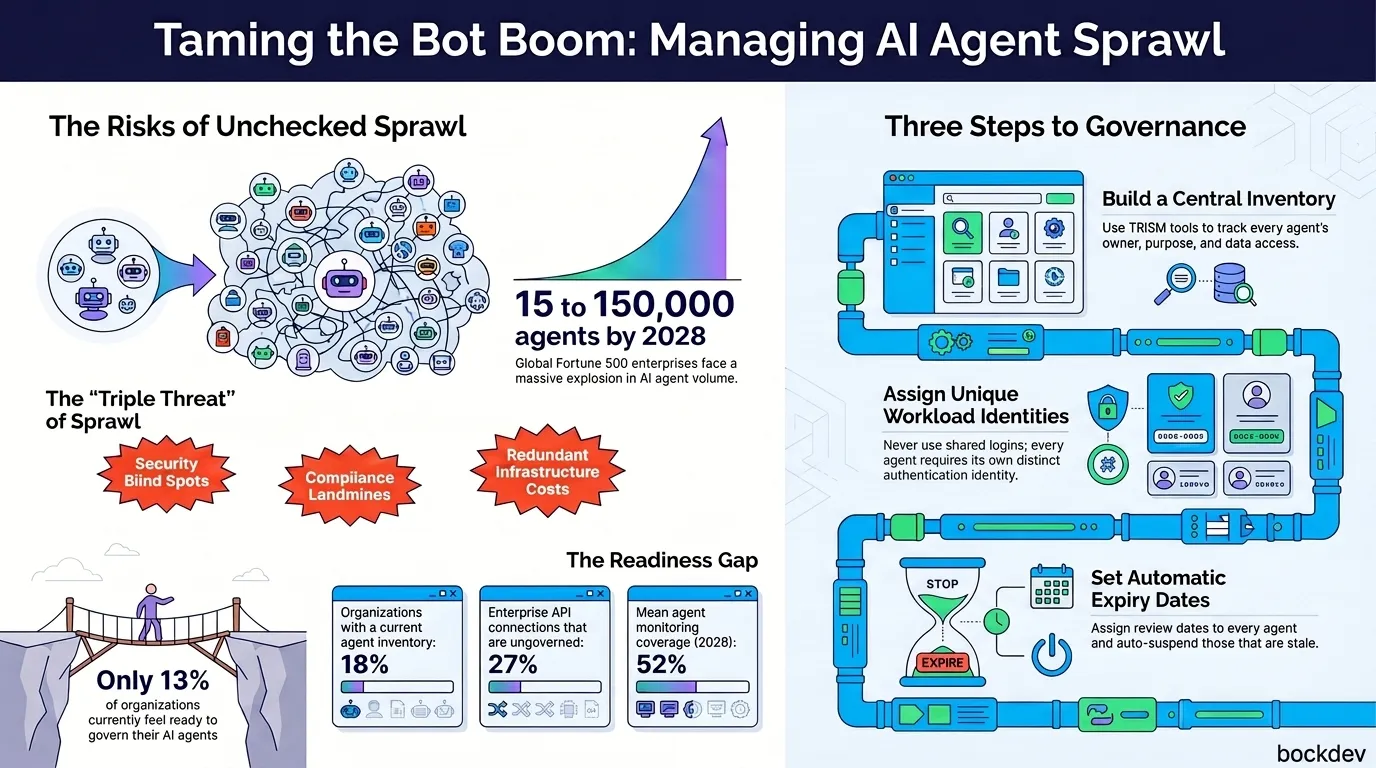
This is agent sprawl, and it's one of the fastest-growing problems in enterprise IT right now. Gartner predicts that by 2028, an average global Fortune 500 enterprise will have over 150,000 agents in use, up from fewer than 15 in 2025. The good news: it's fixable, and it doesn't require slowing down AI adoption to do it.
What Is Agent Sprawl, Exactly?
Agent sprawl is the uncontrolled, decentralized spread of AI agents across an organization, without central tracking, ownership, or security review.
It's not one bad decision. It's hundreds of small, reasonable ones that pile up. A team adopts a meeting transcription tool. Another spins up a contract-review bot. Developers connect coding assistants straight to internal repos. Each choice looks harmless in isolation.
The result, though, is a shadow workforce. Agent sprawl happens when AI agents multiply across an organization without enough visibility, ownership, governance, lifecycle control, security boundaries, or cost discipline.
Think of it like the early days of "shadow IT," when employees signed up for SaaS tools without telling IT. Except now those tools can act on their own, using real credentials, inside real systems.
Why Does This Happen So Fast?
Building an agent today takes a weekend, not a quarter. That's the whole problem in one sentence.
A few forces push this along:
- Low barrier to entry. No-code agent builders mean any team can spin one up.
- No central gatekeeper. Most companies have no single place that tracks "every agent we run."
- Fast wins, slow oversight. A working prototype ships in days; a governance policy takes months.
- Overlap nobody notices. Marketing builds a content research agent. Sales builds an account research agent. Customer success builds a customer research agent, and nobody checks how much of that work overlaps.
The pattern repeats from past tech waves. Uncontrolled growth happens whenever the speed of adoption outpaces the maturity of the governance infrastructure around it, just like it did with cloud and SaaS before this.
What's the Actual Risk Here?
It's tempting to treat this as a tidiness problem. It isn't. Three things make agent sprawl genuinely dangerous.
1. Security blind spots. Agents often run with more access than they need. Agents are frequently granted broader access than their function requires, often rooted in shared service accounts or inherited credentials. If one agent gets compromised, the blast radius can be huge.
2. Compliance exposure. Ungoverned agents touching customer data is a regulatory landmine. Ungoverned agents can access sensitive data without audit trails and create compliance violations under regulations like GDPR, HIPAA, or SOX.
3. Wasted money. Duplicate agents mean duplicate costs. Agent sprawl leads to redundant integrations, unnecessary token usage, and rising infrastructure costs that nobody is tracking against ROI.
Here's the scale of the gap between awareness and readiness:
| Metric | Figure |
|---|---|
| Fortune 500 agents projected by 2028 | Over 150,000 |
| Fortune 500 agents in 2025 | Fewer than 15 |
| Orgs that feel governance-ready | 13% |
| Orgs with a complete, current agent inventory | 18% |
| Mean agent monitoring coverage (April 2026) | 52% |
| Enterprise API connections that are ungoverned | 27% |
How Do You Actually Fix It?
You don't fix sprawl by banning agents. Blocking or restricting AI agent use isn't a long-term solution, because employees who can't use sanctioned tools will route around controls and turn to shadow AI instead, which carries far greater risk.
The fix is structure, not restriction. Here's a practical six-part approach, based on the framework Gartner laid out in 2026:
1. Set governance rules first
Decide who can build an agent, what data it can touch, and which connectors are approved before more agents get built.
yaml
# Example: agent governance policy snippet
agent_policy:
  approved_builders: ["IT", "Platform Team"]
  requires_approval_from: "Security"
  allowed_connectors:
    - internal_crm
    - support_ticketing
  disallowed_connectors:
    - personal_email
    - unmanaged_cloud_storage
2. Build one central inventory
You can't govern what you can't see. Organizations can use AI trust, risk, and security management (TRiSM) tools to discover and categorize agents across both sanctioned tools and shadow AI.
A simple internal registry might look like this:
agent-registry/
├── sales/
│   ├── outreach-bot.yaml
│   └── lead-scorer.yaml
├── support/
│   ├── triage-agent.yaml
│   └── refund-handler.yaml
└── finance/
    └── invoice-checker.yaml
Each file should record an owner, a purpose, an expiry date, and the data it can access.
3. Give every agent its own identity
Never let agents share a login. Each agent should authenticate as a distinct workload identity, such as a dedicated managed identity or service principal, never a human-delegated or shared token.
json
{
  "agent_id": "refund-handler-001",
  "identity_type": "service_principal",
  "owner": "support-team@company.com",
  "scopes": ["read:tickets", "write:refunds"],
  "review_date": "2026-12-01"
}
4. Set expiry dates, not "forever" agents
Every agent should be assigned an owner and an expiry or review date at registration, and unowned or stale agents should be auto-suspended.
5. Use a control plane, not a spreadsheet
Manual tracking won't scale past a handful of agents. Dedicated platforms now exist specifically for this. Microsoft's Agent 365, for example, can sync with AWS Bedrock and Google Cloud to automatically discover, inventory, and govern agents across platforms.
6. Decommission properly
Turning off an agent isn't enough. Decommissioning should revoke the agent's identity and its credentials, not just shut down the endpoint, or the access lingers.
Identity Sprawl vs. Context Sprawl: What's the Difference?
Most teams only solve half the problem. There are actually two distinct issues hiding under one name.
| Type | What it means | What fixes it |
|---|---|---|
| Identity sprawl | Agents nobody tracks, owns, or reviews | Governance, inventory, access controls |
| Context sprawl | Agents that each build their own, disconnected understanding of the business | A shared context or semantic layer |
Agent sprawl has two dimensions: identity sprawl, meaning ungoverned agents, and context sprawl, meaning agents with no shared understanding of the business. Fixing identity sprawl alone still leaves you with five well-governed agents giving five different answers to the same question.
How Do You Know If You Already Have a Sprawl Problem?
A few warning signs tend to show up before anyone calls it "sprawl":
- Different teams give conflicting answers pulled from different agents.
- Nobody can say how many agents are currently running.
- An agent is still active even though the person who built it left the company.
- Two departments discover, by accident, that they built the same tool.
- Security can't say what data a given agent can reach.
If two or more of these sound familiar, sprawl has likely already started.
My SaaS
Acluebox
Build modular and reusable system prompts with my SaaS,
Acluebox
. Also, free prompt template generators there. Q&A
1. What is agent sprawl in simple terms?
It's when AI agents spread across a company faster than anyone can track or manage them, leaving gaps in security and oversight.
2. Is agent sprawl the same as shadow AI?
Not exactly. Shadow AI is agents built without IT's knowledge. Agent sprawl includes shadow AI but also covers approved agents that simply aren't governed well.
3. Why can't companies just block unapproved agents?
Because employees who are blocked from sanctioned tools tend to go around controls instead, which creates even bigger shadow AI risks.
4. How many AI agents does a typical large company run?
Active deployers in early 2026 were already running 76 to 100 agents and doubling roughly every quarter.
5. What's the single biggest fix for agent sprawl?
Building a complete, current inventory of every agent. Only 18% of organizations currently have one, making it the most overlooked fix available.
6. Does agent sprawl only affect security teams?
No. It also drives up infrastructure costs, creates compliance risk, and produces inconsistent outputs across departments.
7. What's context sprawl?
It's when separate agents each build their own version of "how the business works," with no shared source of truth between them.
8. Can small companies have agent sprawl too?
Yes. Sprawl is about the ratio of agents to governance, not raw headcount. A small team with five ungoverled agents can have the same exposure as a large one.
9. What regulations make agent sprawl riskier?
Frameworks like the EU AI Act, GDPR, HIPAA, and SOX all raise the stakes, since ungoverned agents touching regulated data can trigger violations.
10. What tools help manage agent sprawl?
Dedicated agent management platforms, such as Microsoft Agent 365, Google's Gemini Enterprise Agent Platform, and AI TRiSM tools, are built specifically to discover, inventory, and govern agents at scale.
References
- Gartner Identifies Six Steps to Manage AI Agent Sprawl - https://www.gartner.com/en/newsroom/press-releases/2026-04-28-gartner-identifies-six-steps-to-manage-artificial-intelligence-agent-sprawl
- AI Agent Sprawl: What It Is, Why It Happens, and How to Stop It - https://www.kore.ai/blog/what-is-ai-agent-sprawl
- What is AI agent sprawl? Is it harder to contain than shadow AI? - https://www.wiz.io/academy/ai-security/ai-agent-sprawl
- What Is Agent Sprawl and Context Sprawl? Causes, Risks, and Fixes - https://atlan.com/know/ai-agent/agent-sprawl/
- Microsoft Agent 365, Now Generally Available, Expands Capabilities and Integrations - https://www.microsoft.com/en-us/security/blog/2026/05/01/microsoft-agent-365-now-generally-available-expands-capabilities-and-integrations/
- The State of AI Agent Security 2026 - https://www.gravitee.io/state-of-ai-agent-security