
What’s New in Claude Opus 5? The Most Surprising Changes Explained
Explore Claude Opus 5's frontier capabilities, from deep reasoning to mid-conversation tool changes.
AnthropicClaudeOpus 5

Learn what's new in Claude Opus 4.7. Review specs, visual verification upgrades, API breaking changes, task budgets, and step-by-step migration tips.
If you've been using Claude for anything serious, such as building agents, processing documents, or handling complex reasoning tasks, you know how much the model version matters. A new release can mean faster results, smarter outputs, and fewer workarounds in your code.
Claude Opus 4.7 is Anthropic's most capable generally available model yet. It's built for long, autonomous tasks, better vision, and smarter memory. But it also comes with real breaking changes that will affect your existing API code if you don't update it.
This post cuts through the official docs and gives you only what matters: what's new, what broke, what changed in behavior, and how to migrate cleanly.
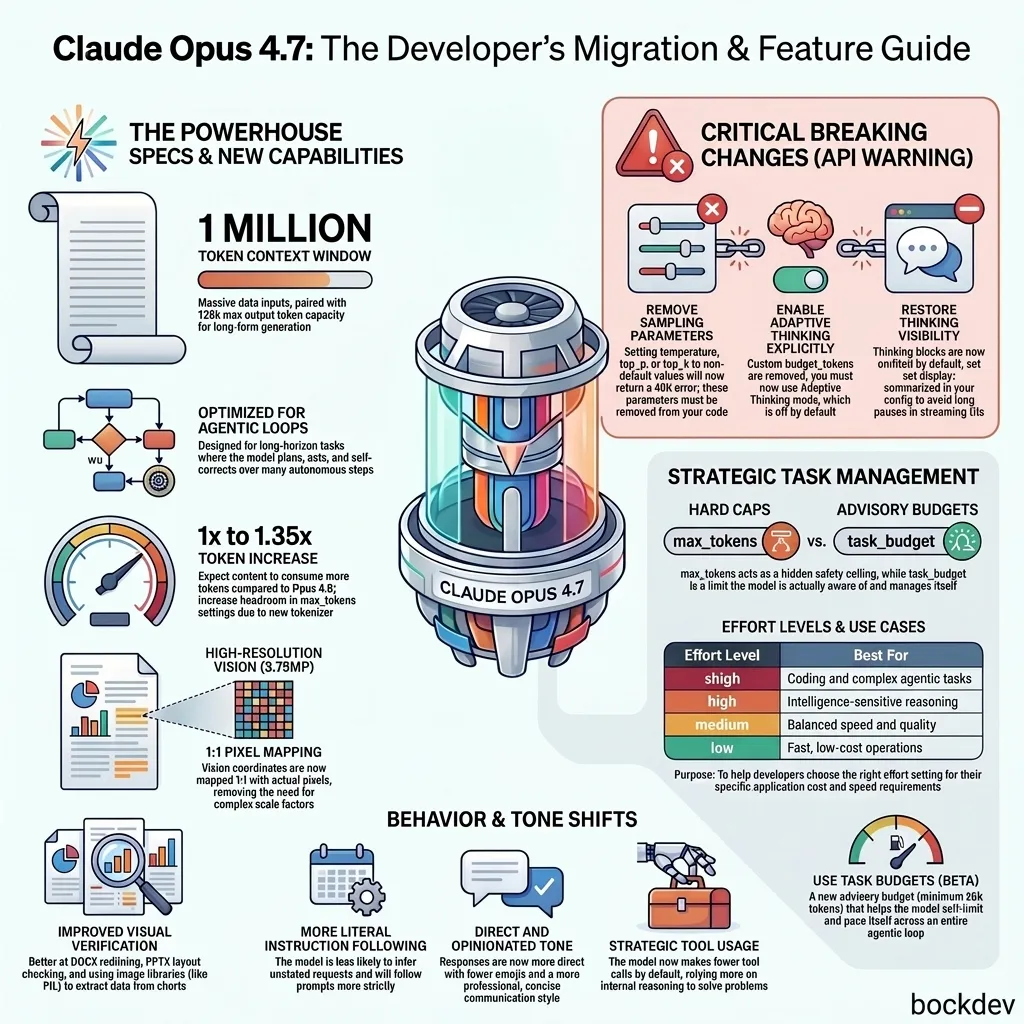
Claude Opus 4.7 is Anthropic's flagship large language model designed for complex reasoning, multi-step planning, and agentic workflows. Featuring a 1-million-token context window and up to 128k output tokens per request, Opus 4.7 introduces native adaptive thinking, high-resolution visual processing, and task budget controls, while introducing breaking API changes around sampling parameters.
It is specifically optimized for long-horizon tasks where the model must plan, interact with tools, and self-correct autonomously over many steps.
Opus 4.7 is the first Claude model to support high-resolution images. The maximum resolution jumped from 1568px / 1.15MP to 2576px / 3.75MP.
This matters most for:
One practical improvement: coordinates are now 1:1 with actual pixels. You no longer need to apply a scale factor when mapping pixel positions.
Heads up: High-res images consume more tokens. If you don't need the extra detail, downsample your images before sending them to avoid unnecessary cost.
xhigh Effort Level The effort parameter lets you trade model intelligence for speed and cost. Opus 4.7 adds a new xhigh level at the top.
| Effort Level | Best For |
|---|---|
xhigh | Coding, agentic tasks |
high | Most intelligence-sensitive tasks |
medium | Balanced speed and quality |
low | Fast, low-cost tasks |
This is available in the Messages API only. If you use Claude Managed Agents, effort is handled automatically.
Task budgets let you tell Claude roughly how many tokens to use across an entire agentic loop, including thinking, tool calls, and output. Claude sees a running countdown and adjusts its work accordingly.
To use it, set the beta header and add task_budget to your output_config:
response = client.beta.messages.create(
    model="claude-opus-4-7",
    max_tokens=128000,
    output_config={
        "effort": "high",
        "task_budget": {"type": "tokens", "total": 128000},
    },
    messages=[
        {"role": "user", "content": "Review the codebase and propose a refactor plan."}
    ],
    betas=["task-budgets-2026-03-13"],
)
Key distinctions:
| Parameter | Type | What It Does |
|---|---|---|
max_tokens | Hard limit | Caps tokens per request, model is not aware of it |
task_budget | Advisory | Guides the model to self-limit across the full loop |
Use task_budget when you want the model to manage its own scope. Use max_tokens as a safety ceiling. Minimum task budget is 20k tokens.
These will cause errors in your existing code if not addressed. If you use Claude Managed Agents, none of these apply.
Setting budget_tokens in the thinking config now returns a 400 error.
# Before (Opus 4.6)
thinking = {"type": "enabled", "budget_tokens": 32000}

# After (Opus 4.7)
thinking = {"type": "adaptive"}
output_config = {"effort": "high"}
Adaptive thinking is the only supported thinking mode now, and it's off by default. You must enable it explicitly.
Setting temperature, top_p, or top_k to any non-default value now returns a 400 error.
The fix: remove these parameters from your requests entirely. If you used temperature = 0 for determinism, note that it never actually guaranteed identical outputs anyway.
Thinking blocks are still generated but the thinking field in the response is now empty by default. No error is raised, it just silently omits the content.
If you stream reasoning to users, this will appear as a long pause before output begins. To restore visible progress:
thinking = {
    "type": "adaptive",
    "display": "summarized",  # or "omitted" (default)
}Opus 4.7 uses a new tokenizer. Expect roughly 1x to 1.35x more tokens compared to Opus 4.6 for the same content, depending on the workload.
What to do:
max_tokens values to give more headroomtask_budget and effort to control cost without sacrificing too much qualityOpus 4.7 is better at tasks that require visual verification of its own outputs:
If you added prompts like "double-check the slide layout before returning," try removing those and re-testing. The model may handle it natively now.
The model is better at writing to and reading from file-system-based memory. If your agent uses a scratchpad or structured notes file, expect improved consistency across turns.
You can also use the built-in memory tool to give Claude a managed scratchpad without building your own.
| Behavior | What Changed |
|---|---|
| Instruction following | More literal, will not infer unstated requests |
| Response length | Calibrates to task complexity, not a fixed verbosity |
| Tool usage | Fewer tool calls by default, uses reasoning more |
| Tone | More direct and opinionated, fewer emoji |
| Progress updates | More frequent status updates during long agentic runs |
| Subagents | Fewer spawned by default, steerable via prompting |
| Cybersecurity | May refuse high-risk topics, apply to Cyber Verification Program for legitimate work |
1. Is Claude Opus 4.7 a drop-in replacement for Opus 4.6?
Mostly, but not entirely. If you use the Messages API and set temperature, top_p, top_k, or budget_tokens, your requests will return 400 errors. Review the breaking changes section before switching.
2. What is adaptive thinking and how do I enable it?
Adaptive thinking is Claude's only supported reasoning mode in Opus 4.7. It's off by default. Enable it by setting thinking: {"type": "adaptive"} in your request.
3. What happens if I don't update my sampling parameters?
Any non-default value for temperature, top_p, or top_k will return a 400 error. The safest fix is to remove those parameters entirely.
4. What is the difference between task_budget and max_tokens?
max_tokens is a hard per-request cap that the model is not aware of. task_budget is an advisory budget across the full agentic loop that the model actively uses to pace itself.
5. Why do my images now cost more tokens?
High-resolution image support uses more tokens per image. If you don't need the extra detail, resize or compress images before sending them to Claude.
6. My streaming UI now shows a long pause before output. What's wrong?
Thinking content is now omitted by default. Set "display": "summarized" in your thinking config to restore visible progress during reasoning.
7. Will existing Opus 4.6 prompts work as-is?
Possibly, but expect behavior differences. The model is more literal, more direct, uses fewer tools by default, and calibrates response length to task complexity. Test your key prompts before migrating in production.
8. Can I still use extended thinking with a custom token budget?
No. Extended thinking budgets are removed entirely. Use adaptive thinking with an effort level instead. Internally, adaptive thinking outperforms the old extended thinking mode.
9. What is the xhigh effort level for?
It's the highest effort level, recommended for coding and agentic tasks where quality matters most. Use at least high for any intelligence-sensitive work.
10. How do I migrate my codebase automatically?
If you use Claude Code or the Agent SDK, the Claude API skill can apply migration changes to your codebase automatically. Otherwise, follow the step-by-step migration guide in the official docs.
Tags
Explore Claude Opus 5's frontier capabilities, from deep reasoning to mid-conversation tool changes.
This guide breaks down what's actually new for the Anthropic's latest Sonnet-tier model, Claude Sonnet 5.

Learn about Claude Fable 5 and Mythos 5. Review specs, API changes, refusal handling, fallback configurations, and details on their global suspension.

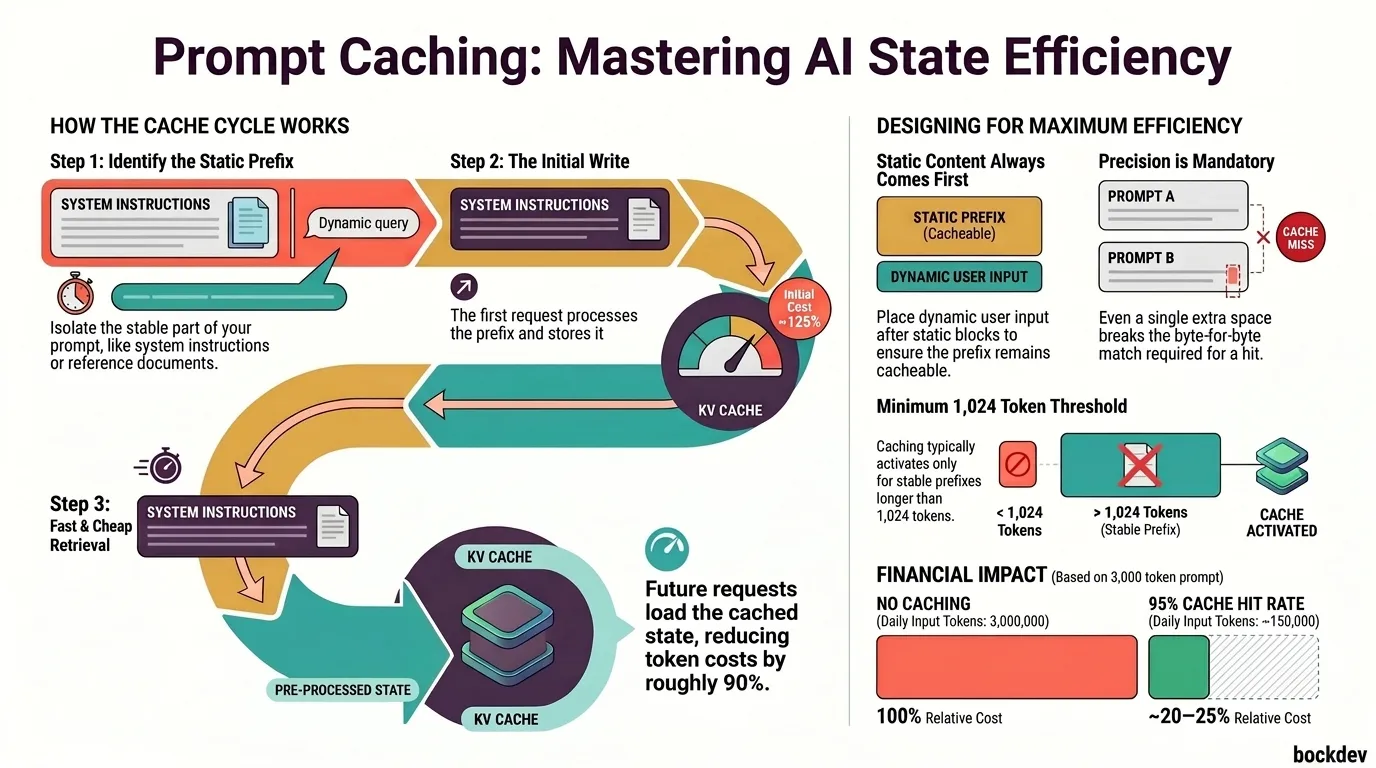
Learn how prompt caching works in large language models, why it reduces API costs and latency, and how to design your prompts and system state to take full advantage of it.
A clear breakdown of everything new in Claude Opus 4.8, including fast mode, mid-conversation system messages, lower prompt cache minimum, refusal stop details, and behavior improvements.